


Take your agent’s memory anywhere
'%3e%3cellipse%20cx='607.097'%20cy='536.597'%20rx='220'%20ry='149.5'%20fill='url(%23paint0_linear_0_4)'/%3e%3c/g%3e%3cdefs%3e%3cfilter%20id='filter0_f_0_4'%20x='0'%20y='0'%20width='1214.19'%20height='1073.19'%20filterUnits='userSpaceOnUse'%20color-interpolation-filters='sRGB'%3e%3cfeFlood%20flood-opacity='0'%20result='BackgroundImageFix'/%3e%3cfeBlend%20mode='normal'%20in='SourceGraphic'%20in2='BackgroundImageFix'%20result='shape'/%3e%3cfeGaussianBlur%20stdDeviation='193.548'%20result='effect1_foregroundBlur_0_4'/%3e%3c/filter%3e%3clinearGradient%20id='paint0_linear_0_4'%20x1='607.097'%20y1='387.097'%20x2='607.097'%20y2='686.097'%20gradientUnits='userSpaceOnUse'%3e%3cstop%20stop-color='%232F43CB'%20style='stop-color:%232F43CB;stop-color:color(display-p3%200.1826%200.2644%200.7959);stop-opacity:1;'/%3e%3cstop%20offset='1'%20stop-color='%239550C2'%20style='stop-color:%239550C2;stop-color:color(display-p3%200.5828%200.3140%200.7620);stop-opacity:1;'/%3e%3c/linearGradient%3e%3c/defs%3e%3c/svg%3e)



Walrus Memory is a portable memory layer that makes AI agents reliable across apps and sessions. Persistent, verifiable, and fully under your control.
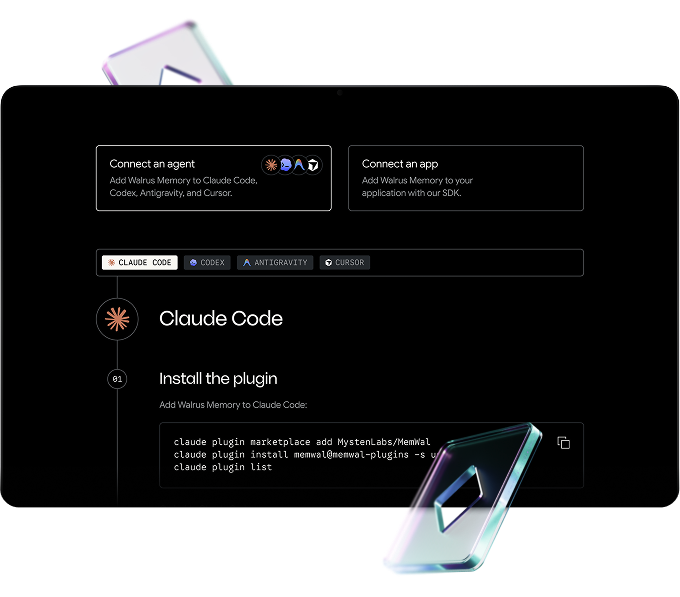
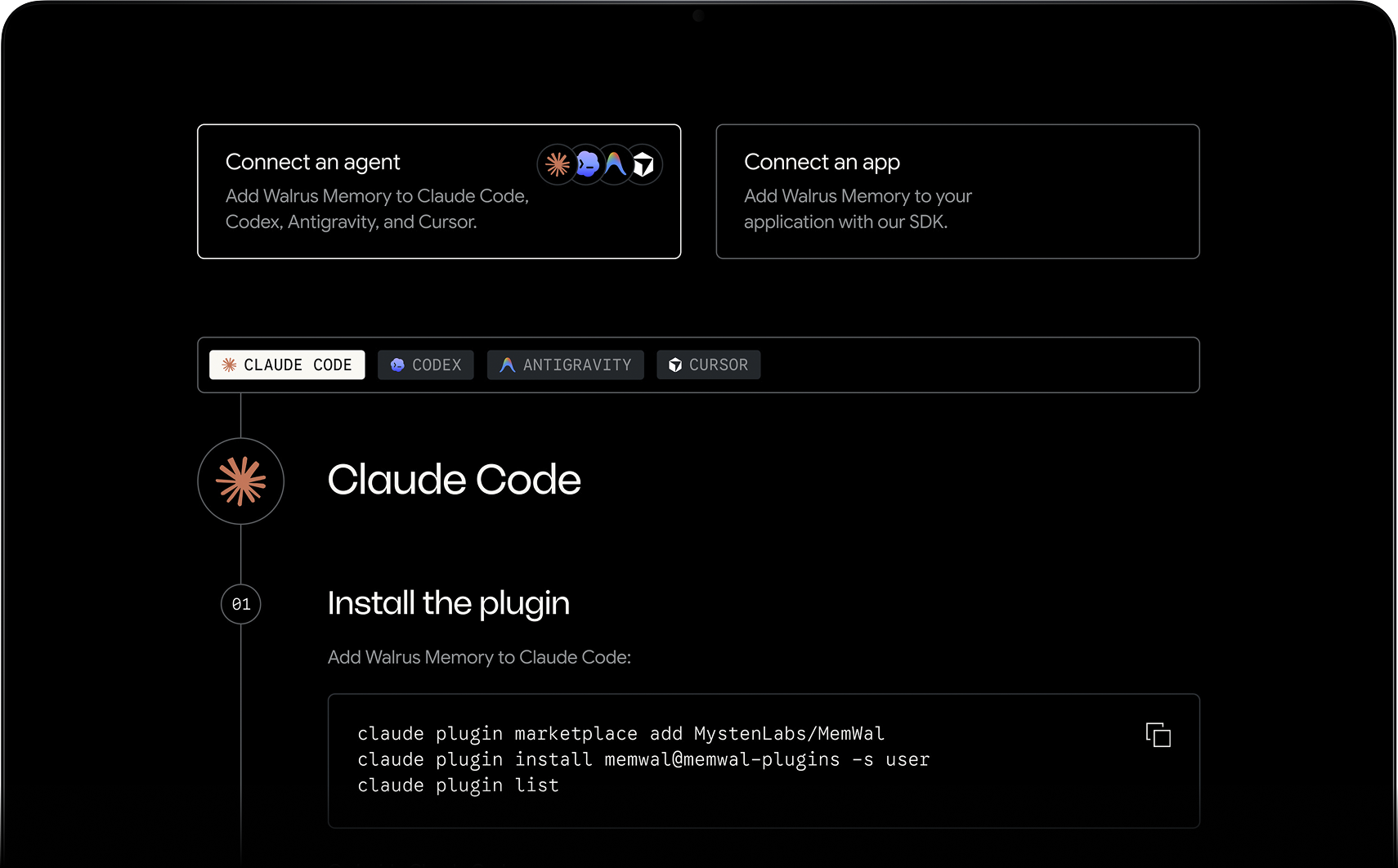
Add Walrus Memory to Claude Code, Codex, Gemini CLI, and more.
Create multi-agent workflows with shared memory.
Add Walrus Memory directly to your application.
Add Walrus Memory to Claude Code, Codex, Gemini CLI, and more.
Create multi-agent workflows with shared memory.
Add Walrus Memory directly to your application.
Builders shipping
with Walrus Memory


Without memory,
agents hit reset

State isn’t shared.
Agents make conflicting decisions.
Memory is stale or unverifiable.
Output isn’t reliable in production.
Your agent makes a call.
There's no audit trail of what it read, when, or why.
A portable memory layer
for AI agents
Portable by design
Context doesn't die when the session ends. Your agent picks up where it left off — in a different app, in a different runtime, weeks later.
Your agents keep context wherever they run
Yours to control
You decide how every memory is shared, accessed, and updated. Programmable permissions, explicit ownership, privacy on your terms.
Explicit privacy and access permissions
Built for coordination
In multi-step workflows, your agents share memory and stay coordinated on the same state. Memory integrity is independently verifiable.
Multiple agents, one source of truth


Plugs into
the stack
you already
have
Walrus Memory ships with native support for the platforms and protocols teams are already building on.
Works with every major LLM out of the box.
First-party plugins for OpenClaw and NemoClaw.
Native MCP support.
No adapters needed.
Python, TypeScript, and JavaScript SDKs.
What builders are creating
with Walrus Memory
A portable agent memory layer doesn’t just improve your stack. It changes how your product behaves – and what users come to rely on. The moat is the memory, not the model.
01 —
Multi-agent workflows
Agents share context across tasks, tools, and time. What one agent learns can become available to the entire workflow.
02 —
Customer support agents
Pick up where the last conversation ended. Know what was tried, what failed, and what the customer actually needs.
03 —
Notes and research apps
A second brain that compounds over time. It captures ideas continuously and retrieves them naturally weeks later.
04 —
Personal assistants
Remember tone, preferences, routines, and relationships. Feel like assistants that know you, not new hires every session.
Memory that holds up
in production

Context travels with the workflow: programmable permissions, verifiable state, no lock-in. Runs on Walrus – the data platform built for the demands of AI.
Remember
Authenticate
Your SDK sends a signed request so the relayer can verify ownership and access.
Process
The relayer analyzes and encodes your memory using embedding models optimized for retrieval.
Encrypt and store
Your memory is encrypted, stored on the Walrus Protocol, and indexed for fast semantic search.
Recall
Authenticate
Your SDK sends a signed query request so the relayer can verify access permissions.
Search
The relayer interprets the query, retrieves the most relevant memories, and fetches them from Walrus.
Decrypt and inject
The memory is decrypted and injected into the model context for downstream reasoning.
Write a memory in one tool.
Recall it in another.

Build agents
that remember
Wire memory into your agent.
Ship without rebuilding context every session.
FAQs
Walrus Memory is a portable memory layer for AI agents. It runs on Walrus, the Verifiable Data Platform, and gives agents persistent, shared, and verifiable memory across sessions, apps, and runtimes.
AI agents often lose memory because most agent experiences are session-based. When the chat, app, or runtime ends, the context window disappears with it. The next session starts from scratch unless the developer has built a persistent memory layer.
That's the source of AI agent memory loss: memory is tied to the session, not the agent. Walrus Memory makes the memory portable instead, so your agent picks up where it left off in a different app, in a different runtime, weeks later.
AI agents store memory by saving context they can retrieve and use later. Most teams build this themselves with vector databases, storage systems, application state, and custom access controls. It works, but often creates fragmented infrastructure with limited portability and few guarantees around ownership, access, or memory integrity.
Walrus Memory keeps memories encrypted before they are stored, while ownership and delegate permissions determine who can access them. Access controls are enforced and independently verifiable, giving developers explicit control over how memory is accessed and shared without building custom infrastructure from scratch.
Portable AI memory means decoupling memory from the app the agent runs in, so the same context can be read and written from anywhere. Walrus Memory does this by storing every memory on Walrus — the Verifiable Data Platform — with programmable permissions that travel with it. Your agent authenticates with a signed request from the SDK and pulls the same memory whether it's running in a chat app, a workflow, or a different framework entirely. No migrations, no adapters, no lock-in.
You can give your AI agent persistent memory by installing the Walrus Memory SDK in Python or TypeScript and wire two calls into your agent: one to remember, one to recall. The SDK handles authentication, encryption, embeddings, and storage on Walrus, so you don't manage vector indexes or infrastructure yourself.
With native MCP support and first-party plugins for OpenClaw and NemoClaw, your agent gets persistent memory across sessions, apps, and runtimes — without rebuilding context every time.
Redis, Postgres, and vector databases are storage primitives. Developers can use them to build agent memory, but they still need to handle things like embeddings, access control, encryption, ownership, and portability themselves.
Walrus Memory is a memory layer built specifically for AI agents. Memories are encrypted, semantically indexed, stored on Walrus, and managed through ownership and delegate permissions. Developers get persistent, portable memory with programmable access controls built in.
You do. Every memory is tied to a signing key you control — only requests signed by that key can read or write it. Permissions are programmable, so you decide which agents access which memories and on what terms. Nothing is shared by default, and no middle layer can read your memories.
Memory is stored on Walrus — the Verifiable Data Platform. Every memory is encrypted before storage and decrypted only when a signed request from an authorized SDK retrieves it. Integrity is independently verifiable, so you can prove a memory hasn't been tampered with.
Create a Walrus Memory account, generate your delegate key, install the SDK, and you’re off to the races. During the launch period, builders can get started with Walrus Memory for free. Usage limits apply, and pricing may evolve over time.
Walrus Memory is a portable memory layer that helps AI agents carry context across apps and sessions without losing continuity.